The Company
Heart of DarknessThe Company is a European trading organization operating along the Congo River, and its pursuit of commercial expansion gives institutional form to the colonial enterprise at the center of Marlow’s account. It recruits captains, maintains river stations, moves manufactured goods inland, and sends Ivory outward. Yet the apparent order of offices, contracts, and trade routes repeatedly gives way to neglect and disorder. The organization’s stated ambition to build an overseas empire and profit from trade is set against the human costs of its operations and the inability of its officials to govern them effectively.
Organization and commercial aims
The Company is described as a continental concern established to trade on the Congo River. Marlow’s childhood fascination with the river’s map leads him to seek command of one of its steamboats; the river’s shape and the prospect of working for the Company together turn a commercial appointment into the object of his journey. His aunt uses her connections to help secure it, and the appointment comes quickly when the Company learns that one of its captains has been killed. The vacancy presents itself to Marlow as an opportunity, while the circumstances behind it already suggest how unstable the Company’s presence can be.
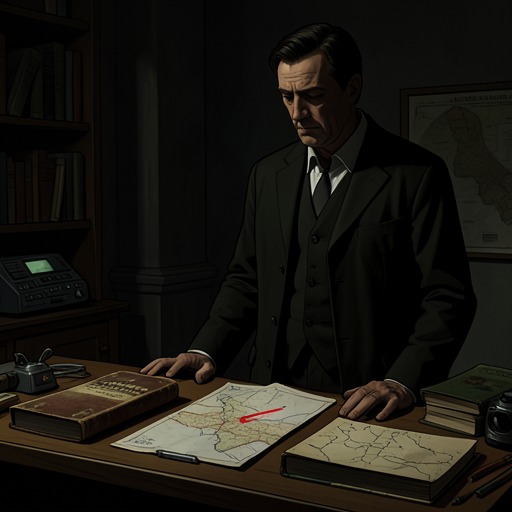
In the European city where Marlow signs his contract, the Company occupies imposing offices and is widely discussed as a major enterprise. Its plans are associated with an overseas empire and large profits from trade. A brightly colored map in its offices makes the geography appear classified and mastered, while Marlow’s attention settles on the river and the region he is to enter. The contrast is important: the map gives commercial expansion a neat visual order, but it cannot convey what the Company’s activities mean on the ground. Before departure, Marlow also signs a document that includes a promise not to disclose trade secrets, placing confidentiality among the formal obligations of his employment.
Stations, personnel, and the movement of goods
At the Company’s first station, Marlow encounters damaged machinery, abandoned equipment, and blasting that appears to accomplish little. The scene introduces a pattern in which activity does not necessarily amount to useful work. Among the people moving through the station are workers employed under time contracts; those who become sick or unable to continue are left to withdraw from the work. Marlow’s account makes the human consequence of the Company’s labor system visible alongside the station’s deteriorating infrastructure, rather than presenting trade as an abstract exchange between offices and markets.
The station’s chief accountant offers a contrasting image of personal discipline. His carefully maintained clothes and orderly books stand out amid the general muddle, and the station’s bookkeeping is conducted there. That limited administrative order does not extend to the larger operation. The Company’s traffic is described as a stream of manufactured goods—among them cheap textiles, beads, and wire—moving inland, while Ivory returns in much smaller quantities. The disparity reveals the commercial logic of the route: assorted goods serve as inputs to exchange, but Ivory is the prized return that gives the movement its purpose.
The journey onward requires a caravan of sixty men carrying heavy loads over a two-hundred-mile route. Marlow encounters abandoned villages, and carriers sometimes die on the march. These details register the demands placed on the people who make the Company’s inland movement possible. At the Central Station, the disorder continues: Marlow waits there while the steamboat he needs remains damaged. Supplies illustrate the failure particularly clearly. Rivets are available in abundance at the coast and even lie scattered around another station, but none are where they are needed to repair the vessel. Meanwhile, caravans continue to bring trade goods. The result is a delay that obstructs the practical work of river transport even as the commercial flow of goods persists.
Management and the limits of control
The General Manager speaks of delayed relief for the upriver stations and of uncertainty over the condition of their personnel. He is especially anxious about Kurtz, whom he identifies as an exceptional and important agent. His concern combines the language of administration with the practical stakes of keeping the Company’s stations operating; Marlow eventually recognizes that the manager’s estimate of the time required to get underway is more accurate than it first seemed. Even so, concern does not translate into effective command. The Central Station remains idle in important respects, and its workers spend time without an evident plan while Marlow struggles to obtain the materials needed for his steamboat.
The Eldorado Exploring Expedition, led by the manager’s uncle, further complicates any picture of a coherent corporate structure. Its declared object is treasure, and Marlow judges its members to be driven by greed rather than by serious preparation or a defensible public purpose. The expedition operates in the same colonial environment as the Company, with close personal ties to its manager, but the account does not portray it as a capable instrument of organized development. Instead, the overlapping presence of officials and private adventurers makes the pursuit of wealth appear diffuse, self-interested, and difficult to distinguish from the Company’s own commercial activity.
Kurtz, Ivory, and the Company’s priorities
Kurtz’s position reveals the tensions between the Company’s dependence on its agents and its limited ability to control them. At the Central Station, the manager describes him as an outstanding agent and worries that his station is threatened and that he is ill. Later, when Kurtz is gravely unwell, the manager assesses him in terms of the harm he has done to the Company and the risk his methods pose to trade. The manager condemns those methods as imprudent, but his stated priority is also to protect the Ivory and restore commercial prospects. His criticism therefore marks a dispute over the conduct and management of extraction, not a rejection of the enterprise’s underlying purpose.
Kurtz’s station holds a large accumulation of Ivory, which is loaded onto Marlow’s steamboat. The Company’s relationship to that stock is contested even in Kurtz’s own claim that he collected it himself and that the Company may try to claim it. The scene makes ownership, collection, and institutional entitlement part of the same struggle: Ivory is not merely a commodity moving through a chain of supply but the object around which Kurtz’s authority and the Company’s commercial claims converge. The manager’s insistence that it must be saved, despite his condemnation of Kurtz’s methods, clarifies the organization’s practical priorities.
Institutional significance
The Company’s operations bring together contracts, maps, bookkeeping, stations, caravans, steamboats, and Ivory, but the narrative repeatedly places these instruments of commerce beside waste, delay, and human suffering. The contrast between goods moving inland and Ivory moving outward gives the trade route a concrete material structure; the shortage of essential repair supplies shows how badly its logistics can fail even while that exchange continues. Meanwhile, the conditions encountered by contracted workers and carriers reveal who bears the physical burden of maintaining the flow.
The organization’s language of progress and orderly administration is consequently tested against what its stations actually produce. Its employees can keep accounts, make appointments, and debate the safest method for preserving trade, yet these procedures do not amount to meaningful restraint or consistent care. The Company appears less as a unified machine than as a commercial power whose agents, managers, and associated expeditions pursue overlapping interests with uneven competence. Its importance lies in that contradiction: it makes imperial extraction possible, while its own failures and priorities expose the distance between the promise of progress and the realities of its business.